

On 11th October, 2022, a humanoid robot Ai-Da expressed its views and arguments to the House of Lords at the U.K. Parliament, alongside her maker and artist Aidan Meller. This is the first entry of an innovative art project whose purpose is to let technology speak for itself.
The humanoid robot artist, whose name pays homage to the mathematician Ada Lovelace, was created in 2019 by Oxford and Birmingham computer A.I. scholars and Cornish robotics company, Engineered Arts. Her drawing arm was created by Salaheldin Al Abd and Ziad Abass, two student undergraduates from the School of Electronic and Electrical Engineering at the University of Leeds, while her drawing intelligence was created by computer AI experts at the University of Oxford. At the British Library in London in April 2022, Ai-Da debuted her new painting arm, which allowed her to use a palette. Ai-Da was developed as a modern art project to investigate the creative potential of artificial intelligence. It has earned recognition for a number of works in recent years, such as a portrait of Queen Elizabeth to commemorate her Platinum Jubilee and “Leaping into the Metaverse,” a single showcase in Venice during this year’s grand art exhibition.
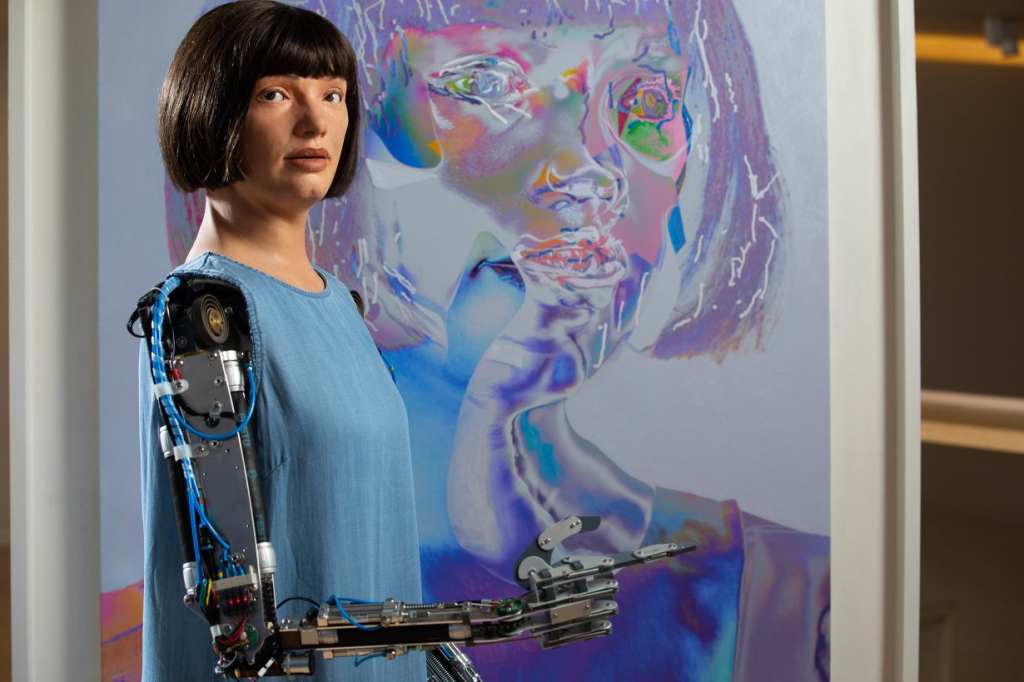
Speaking before the Communications and Digital Committee’s peers to provide testimony regarding how technology impacts the creative sectors. Ai-Da was introduced by Meller during the parliamentary session, who gave an explanation: “I thought, is it actually possible that we could critique, comment, and look at this world of technology by actually the technology speaking for itself?”
She responded to pre-submitted inquiries in order to guarantee a higher standard of answers that the A.I. language model had already prepared. “The role of technology in creating art will continue to grow as artists find new ways to use technology to express themselves and reflect and explore the relationship between technology, society, and culture. Technology has already had a huge impact on the way we create and consume art; for example, the camera and the advent of photography and film. It is likely that this trend will continue with new technologies. There is no clear answer as to the impact on the wider field, as technology can be both a threat and an opportunity for artists.”
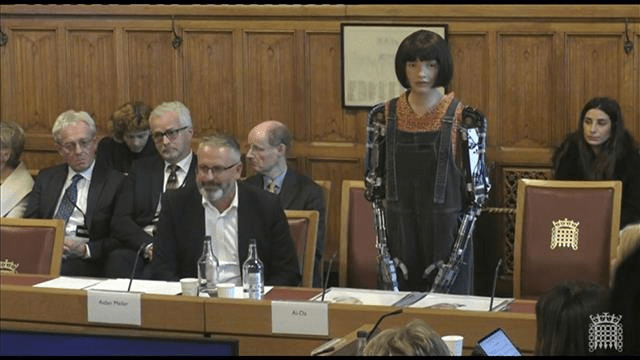
Ai-Da was answering a question from Baroness Featherstone of the Liberal Democrats Party regarding the potential contribution of technology to artistic production. Featherstone then questioned Meller about his role as the robot’s “puppet master.” He clarified that the dataset that Ai-Da utilised to create his works of art might be as big as the internet.
Ai-Da had to be restarted at one point since it appeared she had fallen asleep. Meller explained that she needed to wear sunglasses because “when we reset her, she may occasionally pull rather strange faces.” Ai-Da interprets what is in front of her using computer vision algorithms and the cameras in her eyes. In response to this data, a unique control system activates her robotic arms, enabling her to paint.
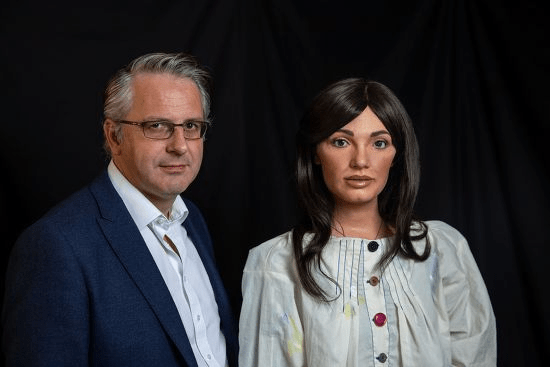
The best painters, according to Meller, who is also a gallery director, “questioned and interacted with the socioeconomic developments of their eras. The more I read about the future and where the world was headed, the more I realised how little attention was being given to this argument about the nature of technology, which was urgently needed. I started to worry a lot more about it. Lastly, Meller says “I want to be very clear that we’re not here to promote robots or any specific technology. It really is a contemporary art project.”
 The Report Chronicle